
















I believe golfers should be able to troubleshoot their own swings if they learn some key things:
* What the club is doing at impact to cause different ball flights
* What they tend to do to cause both good and bad impact conditions
* What thoughts, keys or drills they can do to fix the impact conditions
To this end, step one is being able to correctly diagnose what the golf club is doing at impact to cause the golf shots. Our understanding of these so called “Ball Flight Laws” has changed over the last couple of years so what I am about to write may differ from what you have been told. Trust me, these are not opinion they are fact.
Assuming solid contact, there are two things a golf shot will do:
1. It will start in a direction
2. It will fly straight or curve to the right or to the left
What Causes a Golf Shots Initial Direction?
It used to be thought that a golf shot would start in the direction of the swing path. Unfortunately, all those years, we were wrong. The golf shot will actually start close to where the face of the club is looking at impact. While this is not exactly accurate, it is close enough for this initial discussion.
What Causes a Golf Shot to Curve?
A golf shot curves when the path of the swing is in a different direction than where the face is looking. There are three options for golf shots:
1. The ball flies without curvature – The ball will fly without curvature if the face orientation and path direction are the same. In this case, the ball start in the direction the club is looking at impact and will not curve.
2. The ball flies with a curvature to the RIGHT – The ball will curve to the RIGHT when the face orientation is to the RIGHT of the path direction at impact. In this case, the ball will start where the face is looking and curve to the RIGHT. The amount of curvature to the RIGHT will be determined by how far to the LEFT the path is and how much loft the club has. More difference between path and face and/or a less lofted club will both cause more curvature on the shot.
3. The ball flies with a curvature to the LEFT – The ball will curve to the LEFT when the face orientation is to the LEFT of the path direction at impact. In this case, the ball will start where the face is looking and then curve to the
LEFT. The amount of curvature to the LEFT will be determined by how far to the RIGHT the path is and how much loft the club has. More difference between path and face and/or a less lofted club will both cause more curvature on the shot.
For more information on these ideas, you can do a Google or YouTube search for the phrase “D-Plane”.
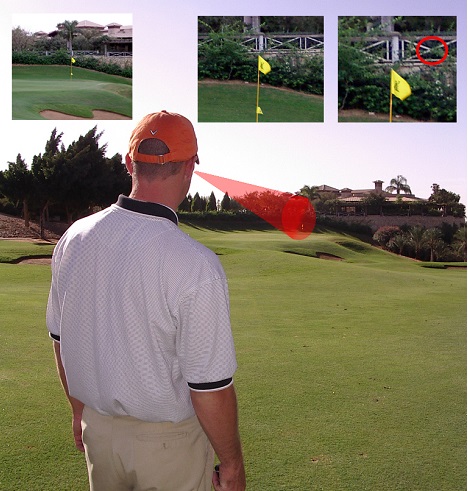
The photo below shows the fact the shot will start roughly where the face is looking and then curve left because the path is to the right of the face.

For those of you who want the exact goods, the shot will actually start about 80% towards the face when there is a difference between the face and path.
Example:
* Face of the club is looking 10 degrees to the left of the target
* Path of the club is directly at the target
* The shot will start 8 degrees to the left and then curve dramatically more to the left in fight
So, in this example, you can hit a shot that starts left and curves much more to the left with a perfect swing path…
If you would like more explanation, please contact me and I would be happy to discuss. Understanding the club to ball relationship is critical if you are ever going to understand your swing so please spend time learning about these facts. If your golf pro is not teaching you this or is using the outdated ball flight laws, you should consider getting a new source for your information. Unfortunately, the old “laws” were easier to understand but they were just wrong and misleading.
For more information on all of the instructional packages that Randle Golf offers click here.





 Loading ...